
Adapted from WESTPEX – The First 50 Years by Kristin Patterson, © 2010 WESTPEX, Inc. · About this history · ↑ History overview
WESTPEX would have been just WEST without the exhibitors, and it wouldn’t have been a competition without judges. This page covers the people who showed their collections, the people who judged them, and the awards they competed for — across fifty years.
Frames and Format
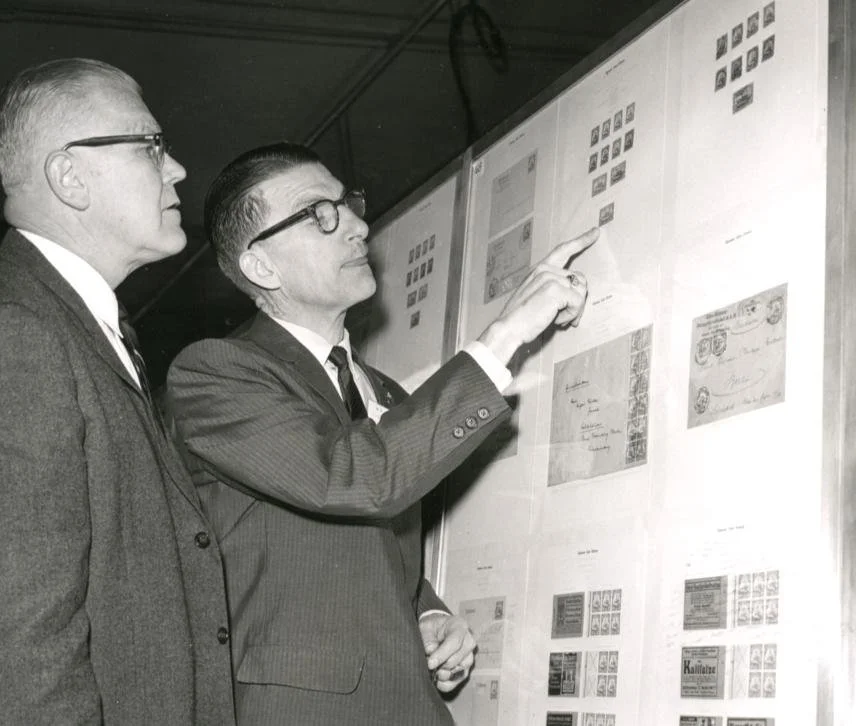
The 1960 Permanent Exhibition Committee spent four and a half years deciding what kind of frame to build. The answer was a custom aluminum 12-page frame — much lighter than the wooden frames used in local shows of the era. Donations and interest-free loans paid for 200 frames before the first show; the frame goal of 300 was hit by the second year.
The frames stayed at 12 pages each for 27 years. In 1987, WESTPEX bought slightly-used 16-page frames from AMERIPEX’86 in Chicago — a 25% capacity increase. The maximum exhibit size dropped from 15 frames to 10. Today the show holds over 320 16-page frames.
Joseph Clary chaired the exhibits committee for the show’s first twelve years. Both he and Cy Thompson were APS-accredited judges. They built the show’s exhibits to be a major attraction, not a sideline.
The Awards System
The very first WESTPEX in 1960 awarded gold, silver, and bronze APS Chapter Awards across thirteen sections — including a section for Western Covers, created because the subject was popular among local collectors and grouped with U.S. and Possessions. From the 13 gold-winning exhibits, the Grand Award went to Reverend John S. Bain for “Canada: Imperial Penny Postage Issue 1898.”
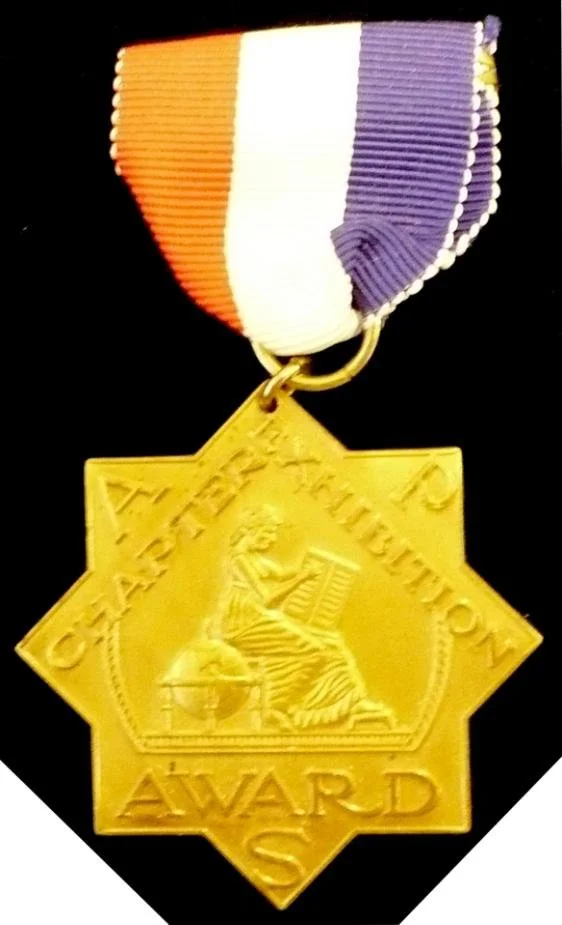
The first awards certificates were donated by Henry Chaloner — “Dean of Philatelists” in the West, 60-year member, secretary, and treasurer of the Berkeley Philatelic Society. The Chaloner Memorial Trophies are now on display at the Western Philatelic Library in Sunnyvale.
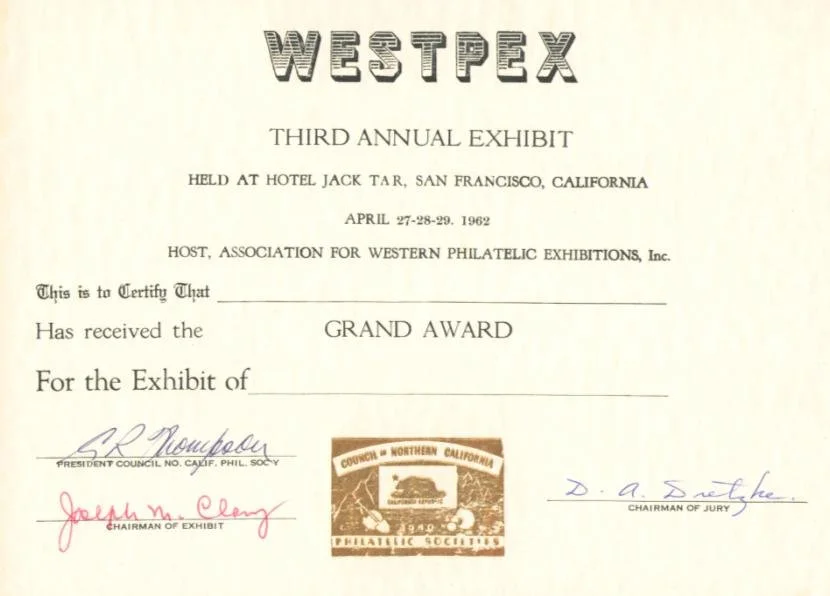
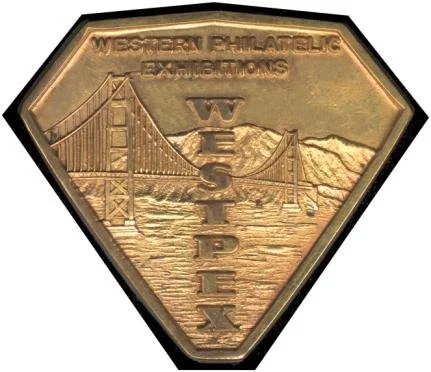
In 1962, WESTPEX created a Championship Class section to allow previous Grand Award exhibits to compete without monopolizing top prizes. Three competed in 1962; the section was discontinued after three years. From 1964, WESTPEX awarded its own medals — and from 1969, the new design became the show’s own. The 1983 redesign by the Medallic Art Company is still in use today.
Award levels grew over time: vermeil (between gold and silver) in 1974, silver-bronze in 1980 — by which point all five medal levels were standardized across APS World Series of Philately shows. WESTPEX, designated a WSP show in 1969, paid Champion-of-Champions entry fees for its Grand Award winners.
The Judges
For five years WESTPEX juries were a mix of accredited and informal judges. In 1965 the APS launched its accreditation program for philatelic judges. WESTPEX immediately committed: by 1966, all twelve members of the WESTPEX jury were APS-accredited judges — at a time when the APS listed only 73 certified judges in the entire country. Thirteen of those 73 were either current WESTPEX volunteers or would become them.
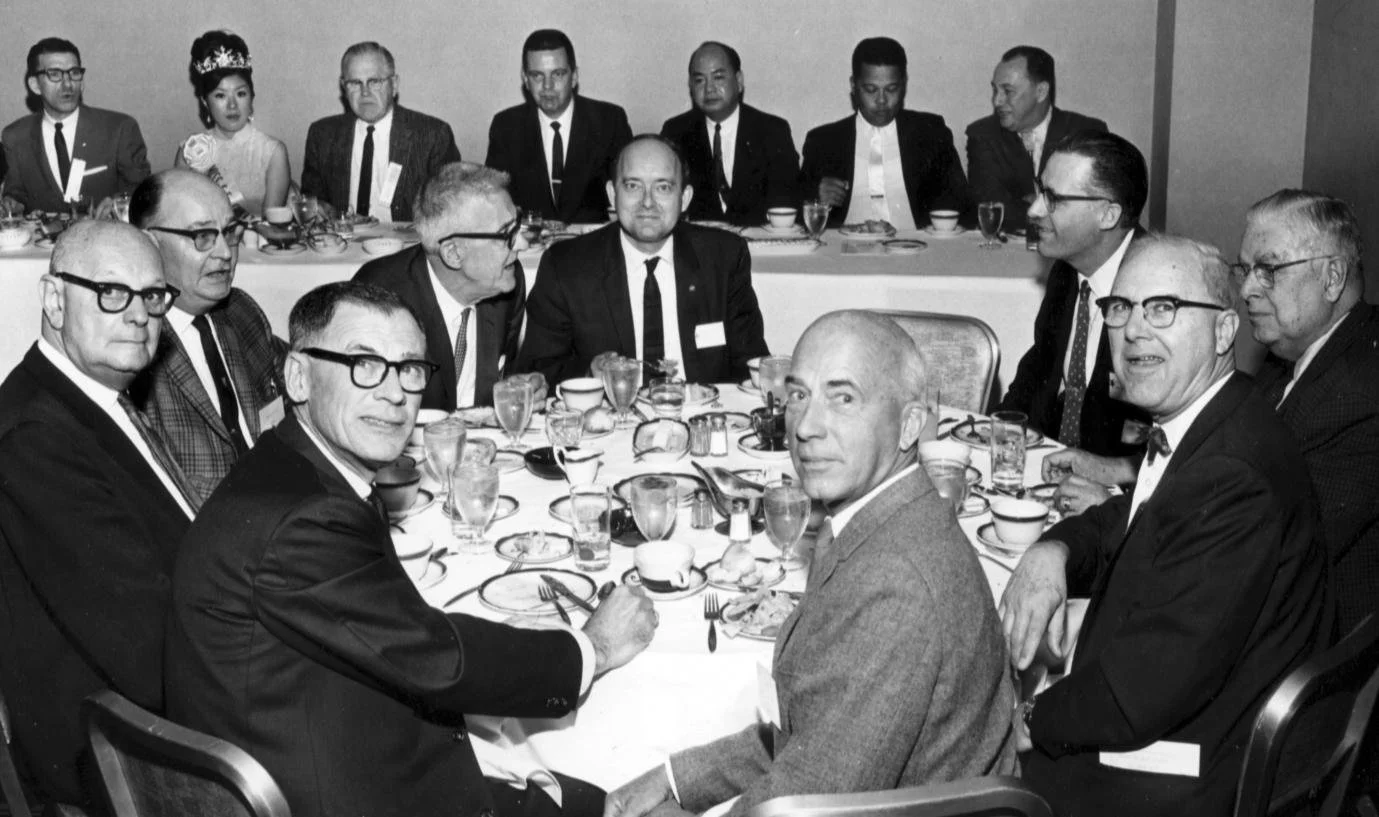
The 1968 WESTPEX jury hit 20 members — 16 judges plus four apprentices — a record number. The next-largest jury was 13. Apprentice judging at WESTPEX has remained a training ground for new philatelic judges ever since.
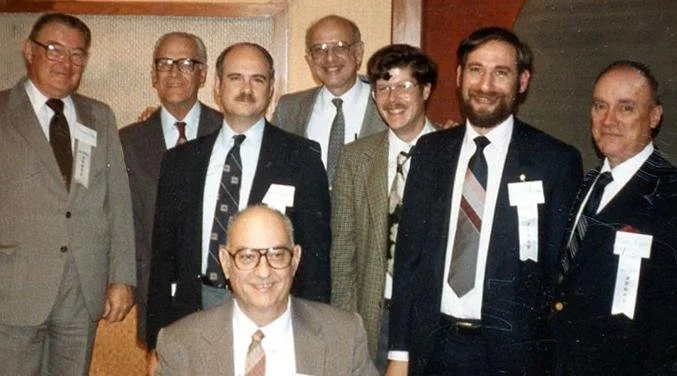
In 1977 WESTPEX added a judges’ critique of exhibits — moved to Saturday afternoon after a 1979 Sunday-morning attempt left the jury chairman unable to attend. The Saturday-afternoon critique continues today.
Notable Exhibits and Wins
From 1969 onward, when WESTPEX became an APS World Series of Philately show, every Grand Award winner became eligible for the APS Champion of Champions competition. Several WESTPEX winners went on to take it:
- 1969: Margaret L. Wunsch, the first woman to win a WESTPEX Grand Award (“U.S. 1869 Issues”). The next year she took the SESCAL Grand and won APS Champion of Champions.
- 1970: Bonnie Eacret — the first WESTPEX volunteer to win the Grand — for “The Provisional Stamps of Canada.” Second consecutive year a woman took the show’s top prize.
- 1978: Ryohei Ishikawa, “United States One Cent Stamp 1851 – 61.” First WESTPEX Grand to also win APS Champion of Champions.
- 1982: Dr. Joseph F. Rorke, “The Black Jacks.” APS Champion of Champions.
- 1983: Harvey Warm, “Postal History of Louisiana.” APS Champion of Champions — the first and only back-to-back WESTPEX wins of the APS title.
- 2002: Arthur K. M. Woo, “Western Australia.” APS Champion of Champions, ending a 19-year gap.
The Court of Honor — non-competitive — has shown extraordinary material across the decades. Highlights: Tadashi Fujita’s complete set of Japan Air Lines first-flight covers (1963); Charles McKeown’s early New Zealand collection (1966); Reverend Eugene Scott’s “Mariana Islands” — accompanied by its own private security guard (1986); the APRL’s recovered “Real McCoy” Inverted Jenny, position 75 of the famous 1918 invert (2004); and the William H. Gross collection “United States Classics, 1847 – 1869,” including the unique 1868 1¢ “Z” Grill valued at $3 million (2007).
The Awards Receptions
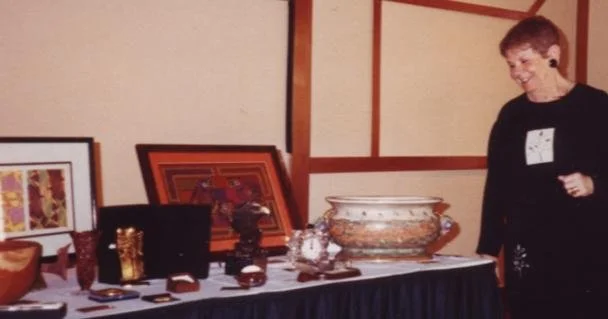
The first WESTPEX awards were presented at the Night Cap Party — the 10 p.m. Saturday closing party in 1960. Food costs killed it after one year, replaced by a Saturday Awards Banquet from 1962. For decades the banquet was a formal affair, with menus often donated by airlines (Pan Am, El Al, Qantas, Aer Lingus, JAL) and customized for the year’s guest society.
In 2001, with attendees increasingly preferring San Francisco restaurants and nightlife, WESTPEX experimented with a 6 p.m. no-host awards reception followed by a 7 p.m. official presentation, freeing visitors for a night out. After three years the reception model was complemented by a Saturday Palmares Dinner, which has continued at the SF Airport Marriott venue since 2004.
Donor and Memorial Awards
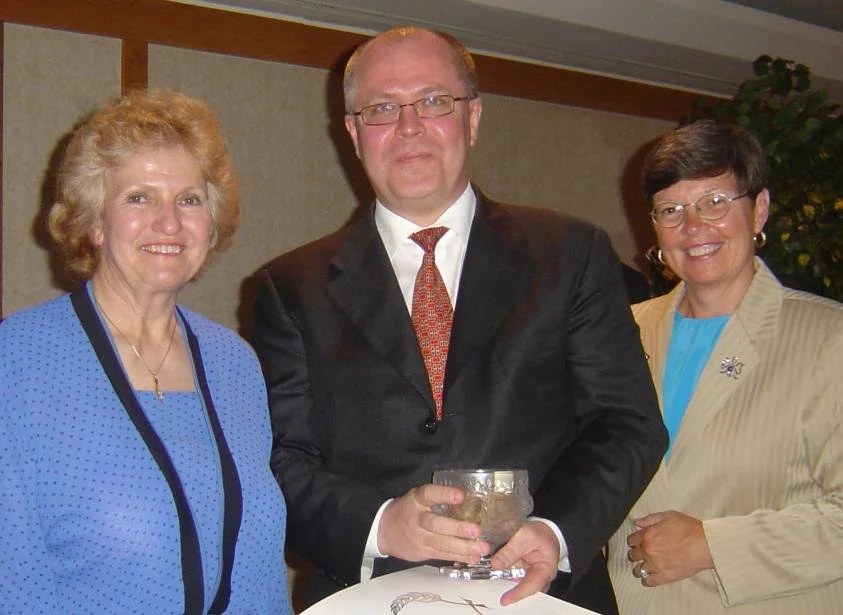
Several long-standing WESTPEX awards were established by individuals who wanted their philatelic passion to outlast them:
- O’Neill Award (best topical, 1972) — donated by Adrienne O’Neill, herself a topical exhibitor and judge, who served thirteen years as WESTPEX secretary.
- Al Van Dahl Memorial Award (best Scandinavian, 1978) — established by Arlene Van Dahl in memory of her late husband, owner-publisher of Western Stamp Collector.
- Wolffers Gold Tongs Award (best classical, 1975) — solid 14kt gold stamp tongs, by Richard Wolffers, the show’s long-time auctioneer.
- Donald Dretzke Memorial Award (best used-stamp exhibit, 2000) — funded by Dretzke’s 1998 bequest. Dretzke was the show’s first jury chairman in 1961.
In 1998 WESTPEX became the first APS World Series of Philately show to introduce the Display Division — a new exhibit class allowing philatelic material to be combined with non-philatelic material to tell a cohesive story. The first WESTPEX Display gold went to twenty-eight-year volunteer Richard Salz for “The Typewriter.”
Across fifty years, 222 judges served on WESTPEX juries. Every Grand Award winner since 1960 — and every juror — is listed in the Honors page.
Adapted from WESTPEX – The First 50 Years by Kristin Patterson, © 2010 WESTPEX, Inc. · About this history →