
Adapted from WESTPEX – The First 50 Years by Kristin Patterson, © 2010 WESTPEX, Inc. · About this history · ↑ History overview
The 2000s were the years WESTPEX moved house, became a non-profit, hosted a rare First Day Ceremony, brought back cachets and souvenir sheets, and finally settled into the venue it still occupies today. Three chairmen handed off across the decade, and the show grew steadily into the form it has now.
Returning, 1998 – 1999
After the year off for Pacific ’97, the 38th show in May 1998 reopened to a letter from new APS president John Hotchner: “WESTPEX is the Crown Jewel of California Philately.” Seventy-five dealers attended, with new early-trade hours Thursday evening and Friday morning at no charge. The Western Philatelic Library set up photomicrograph services for collectors at the show — high-resolution stamp inspection on the spot for a small donation.
1998 was also a year of losses. Ray Erickson, a ten-year volunteer, died March 8 — five days after attending a WESTPEX committee meeting. Past chairman Cyrus Thompson died August 12. Long-time treasurer Agnes Johnson (1971–84) followed in October. November brought the death of Donald Dretzke, the show’s first jury chairman in 1961, who left a bequest funding a perpetual award for the best “Used” stamp exhibit.
The 1999 show found a new auctioneer: Schuyler Rumsey Philatelic Auctions stepped in, and remains the official WESTPEX auctioneer to this day. Volunteer Ross Towle launched www.westpex.com — the show’s first website. Chairman George Shalimoff announced his intention to step down after the 2000 show, following his predecessors’ tradition of retiring at seventy.
The Turn of the Century, 2000 – 2003
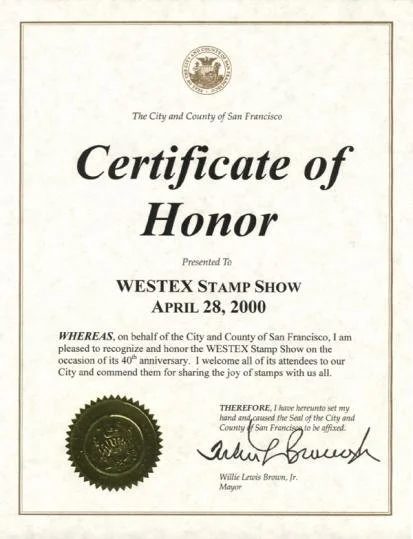
The 40th anniversary show in April 2000 ran with a Certificate of Honor from San Francisco Mayor Willie Brown, who “commended attendees for sharing the joy of stamps with us all.” Edward Jarvis, who had chaired the Awards Committee with his wife Judy and was current chairman of the Collectors Club of San Francisco, stepped in as Shalimoff’s designated successor.
Cachets returned in 2000 after several quiet years. Volunteer Leonard Holmsten, who’d designed the 1999 banquet menus, combined the California state seal with the WESTPEX award medal for a free cachet given to every ticket-buyer. The American Revenue Association as guest society filled 157 frames — the largest revenue exhibit ever assembled at any show.
That year also brought the first sign of stamps’ new digital frontier: an eBay representative gave a two-hour seminar Saturday on buying and selling stamps online.
Shalimoff served one more transitional year in 2001. The Awards Banquet was retired in favor of a no-host bar and reception — visitors increasingly preferred to sample San Francisco’s restaurants and nightlife after the show. The website hit nearly 19,000 visits in April alone.
By 2002 Jarvis was fully chairman, with Gayle Hamilton as secretary — the same role her mother Adrienne O’Neill had held from 1968 to 1974. Don Green received requests for 448 exhibit frames against 308 available; fourteen exhibits had to be turned down. The website saw 40,000 hits in April.
The 43rd show in 2003 ran four guest societies, 36 seminars, and 4 exhibit tours. With 78 dealers crowding the bourse, the admission booth, guest-society tables, and youth area moved down to the street level — the upper mezzanine was full. WESTPEX was expanding.
The Big Move, 2004
The Cathedral Hill Hotel — WESTPEX’s home for 42 of the past 43 years — was being sold to Pacific Medical Group for use as a medical facility. The hotel refused a contract for 2004. The committee had to find a new venue.
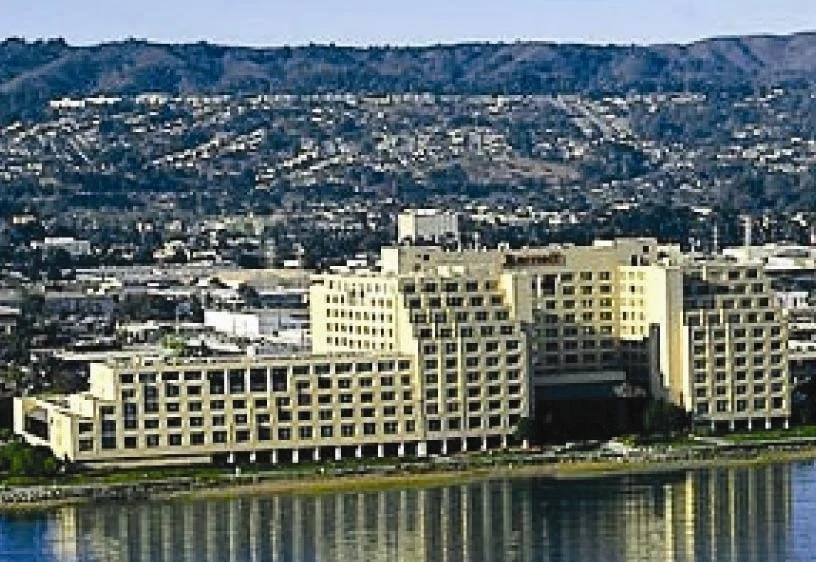
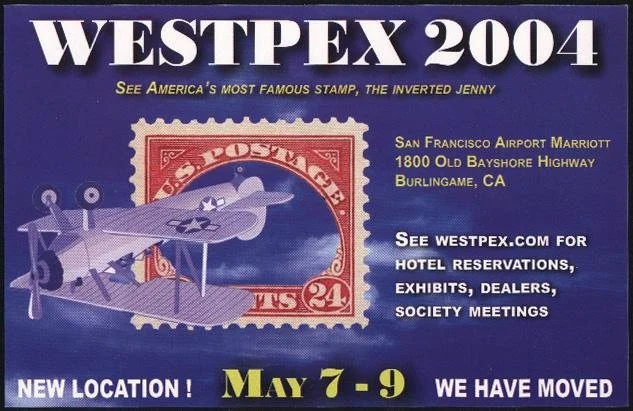
A site survey team — Edward and Judy Jarvis with David McNamee — compared the Concourse Exhibition Center, Hilton Union Square, Fort Mason Center, and Oakland Marriott. None worked. The San Francisco Convention & Visitors Bureau suggested looking near SFO. The team narrowed to two airport-area properties and chose the San Francisco Airport Marriott in Burlingame.
A five-year contract was signed with full convention-facility access, a guaranteed room block, and required food services. Bourse Chair Wayne Menuz packaged dealer booths with three-night room stays. The hotel rate dropped from $127 at Cathedral Hill to $89 at the Marriott. The 2004 show ran May 7 – 9 (the late-April dates weren’t available the first year). The Awards Banquet was reinstated.
For the new venue’s grand opening WESTPEX needed a marquee attraction. The American Philatelic Research Library’s recently-recovered “real McCoy” Inverted Jenny — position 75 of the 1918 invert block, stolen at a 1955 APS show, recovered by the FBI 24 years later, donated to the APRL — had never been the centerpiece of a proper exhibit. WESTPEX volunteers Leonard Holmsten and Kristin Patterson built one: a 17-page exhibit telling the stamp’s story.
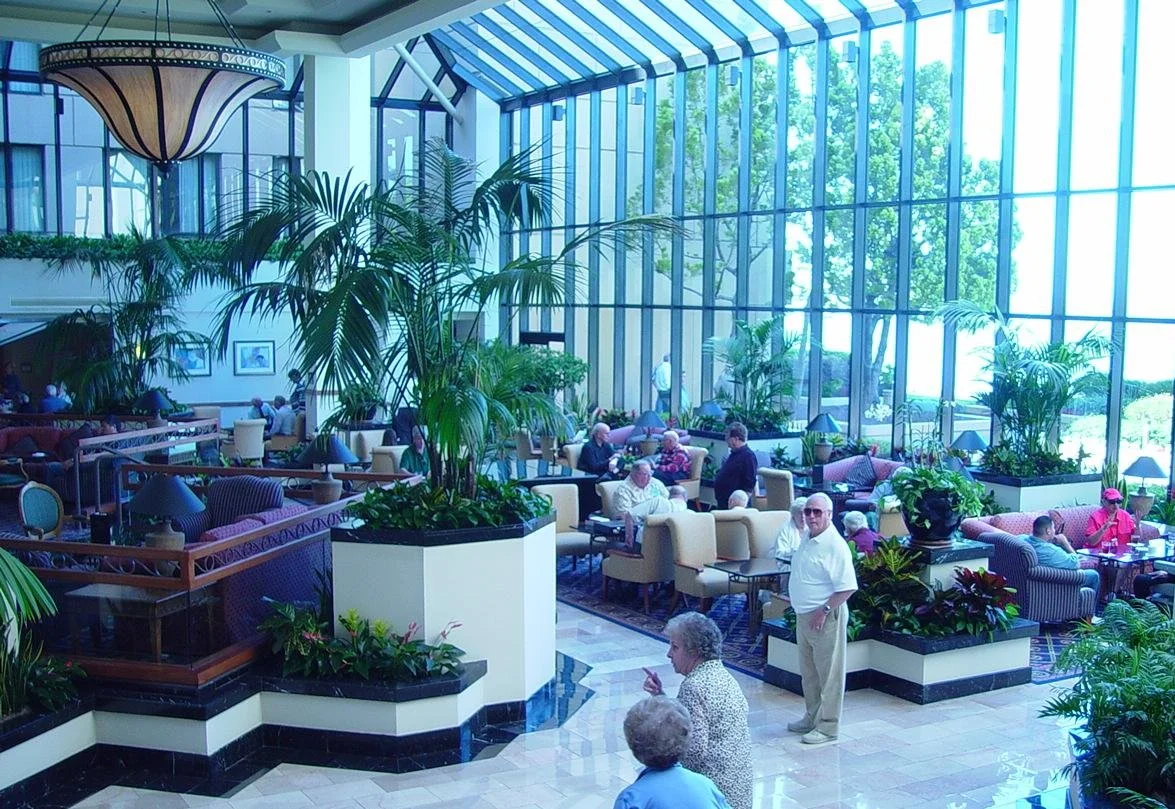
The Marriott proved a hit with attendees. The fresh layout with all dealers and exhibits in one large hall, the modern amenities, the abundant meeting rooms, and especially the lounge area overlooking the bay won immediate enthusiasm.
Settling In, 2005 – 2006
By the 45th show in 2005, the Marriott felt like home. Jarvis appointed a committee to design a “team leader” structure: each volunteer reporting to a team lead, the chairman freed from being the single point of contact for every question. Kristin Patterson took over the show program from bourse chair Wayne Menuz, adding local restaurant ads — even philatelists must eat.
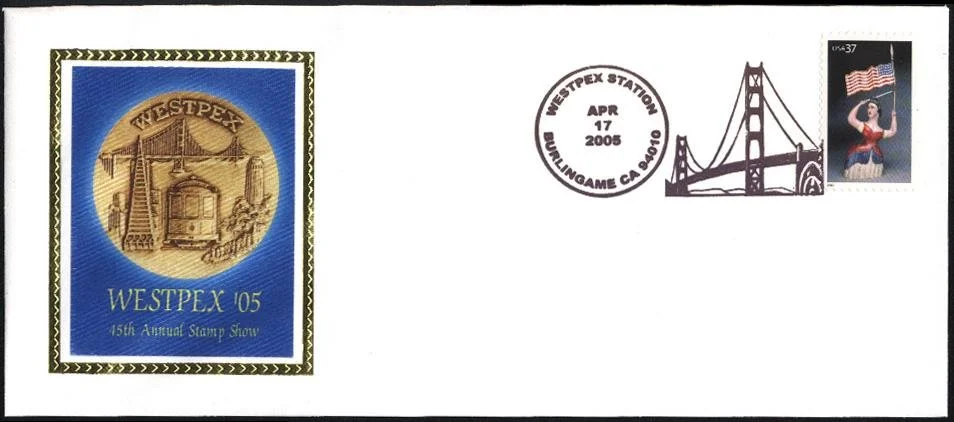
The same year, after years of work led by Nestor Nuñez with Vesma Grinfelds, David McNamee, and Edward Jarvis, WESTPEX was officially granted 501(c)(3) non-profit status under the U.S. Internal Revenue Code. The corporate name became WESTPEX, Inc. The show could now accept tax-exempt donations and operate explicitly “for the public benefit.”
The 2006 show centered on the 100th anniversary of the 1906 San Francisco earthquake — “Up From the Ashes.” The promotional postcard required three printings: the first misspelled the guest society’s name (Helvetia), the second had the British flag upside down, and the third corrected both before anyone caught a copyright issue with the original color image. Talk about another type of philatelic error.
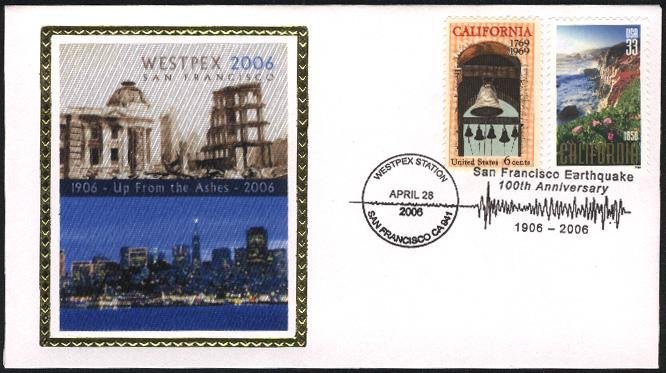
2006 also marked the first time the APS held a Tiffany Dinner at a non-APS-sponsored show. APS President Janet Klug and Executive Director Bob Lamb attended; tickets were $100 with $40 going to the APS endowment. Forty-five paid guests yielded $4,500 in tickets and another $2,971 in donations. WESTPEX matched and increased its support, ending up with a total $25,000 unrestricted donation to the APS that year.
Themes and Theatrics, 2007 – 2009
The 47th show in 2007 took as its theme Joshua Norton, “Emperor Norton I” — the eccentric San Franciscan who, after losing his fortune in the rice market, proclaimed himself emperor and was beloved by the city. Volunteer Dennis Hassler suggested inviting the “emperor” back; actor Rick Silva performed the ribbon-cutting in full regalia, signed souvenir sheets, and attended the Awards Banquet with proclamations of good cheer.
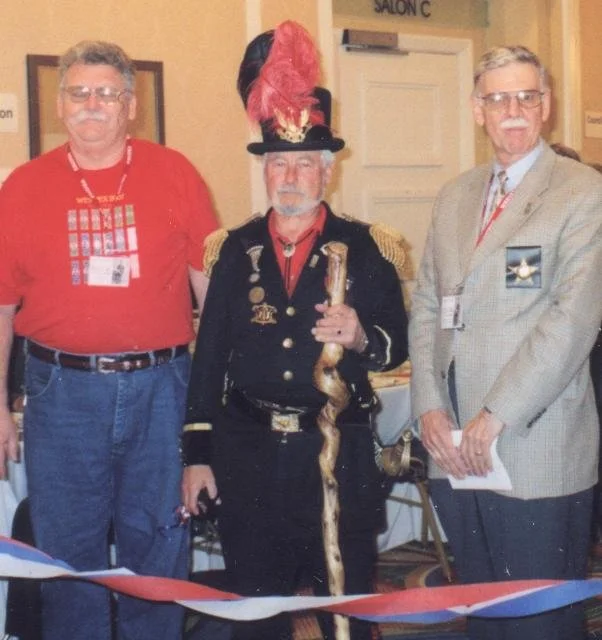
KPIX TV came Friday morning to cover Emperor Norton — and the one-of-a-kind 1868 1¢ “Z” Grill stamp, valued at the time at $3 million, in the Court of Honor exhibit assembled by financier and philatelist William H. Gross. The exhibit, United States Classics, 1847 – 1869 and their 1875 Centennial Special Printings, included every U.S. stamp issued in that period.
Bill Dwyer designed perforated souvenir sheets and a 1.5-inch pewter lapel pin featuring Emperor Norton. WESTPEX also offered Norton-themed bags, hats, mugs, t-shirts, and teddy bears on the website — payment by cash, check, or PayPal.
2008 brought another rare event: a First Day of Issue Ceremony at WESTPEX — the first since 1960. The USPS dedicated the new 27¢ Tropical Fruit definitive stamps in a ceremony in the Irvine Room, Friday April 25, with Burlingame Mayor Rosalie O’Mahony, Postmaster Mary Maldonado, stamp illustrator Sergio Baradat, and USPS Senior Plant Manager Jim Larkin. The USPS provided fresh tropical fruit and brownies for attendees.
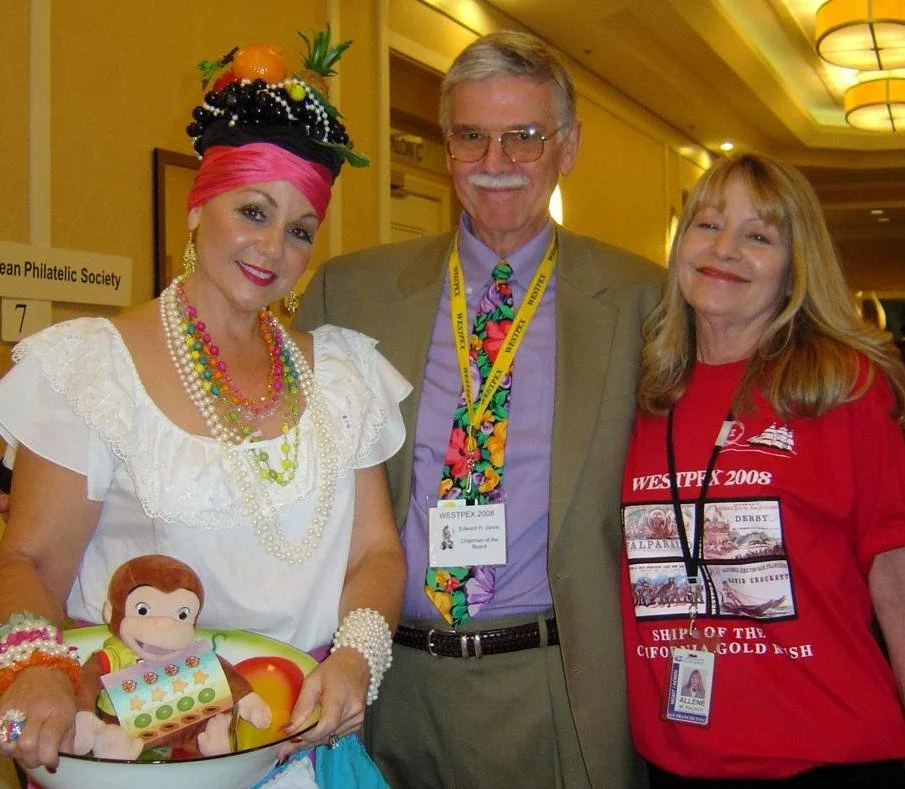
That year’s theme was the 160th anniversary of the discovery of California gold, with Bill Dwyer’s souvenir sheet showing trade cards from clipper ships of the Gold Rush era. The Marriott completed a full renovation. WESTPEX booked 813 room nights at the hotel — a record.
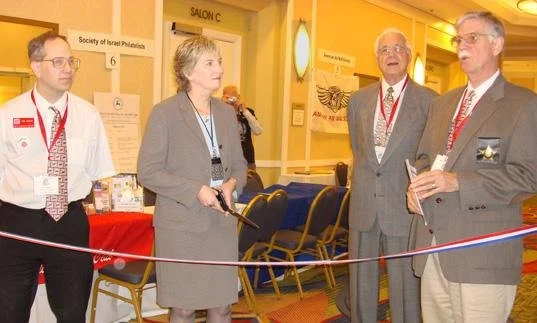
The 49th show in 2009 had grown to a five-day footprint: two APS seminars on Wednesday and Thursday before the show, then 57 scheduled events including 38 society meetings and five docent tours over the weekend. Carol Conroy of the San Mateo Post Office cut the ribbon on opening day.
The Frank and Mae Vignola Award — established in memory of two of the longest-serving WESTPEX volunteers (39 and 35 years respectively) — closed each year by recognizing exemplary committee service. By the end of the decade, the show had honored the Skinners, Nestor Nuñez, Leonard Holmsten, Bill Pratt, and the Eggens.
The first 50 years would close in 2010 — and the show was already planning what came next.
← The 1990s · ↑ All eras · Continue to The 2010s →
Adapted from WESTPEX – The First 50 Years by Kristin Patterson, © 2010 WESTPEX, Inc. · About this history →