
Adapted from WESTPEX – The First 50 Years by Kristin Patterson, © 2010 WESTPEX, Inc. · About this history · ↑ History overview
The 1990s were WESTPEX’s busiest decade. Three different chairmen led the show, the hotel changed names twice, the United Nations Postal Administration held a First Day ceremony at the show, and the year that should have been the 38th WESTPEX became something bigger instead — the year San Francisco hosted the world.
Oliver’s Last Years, 1990 – 1992
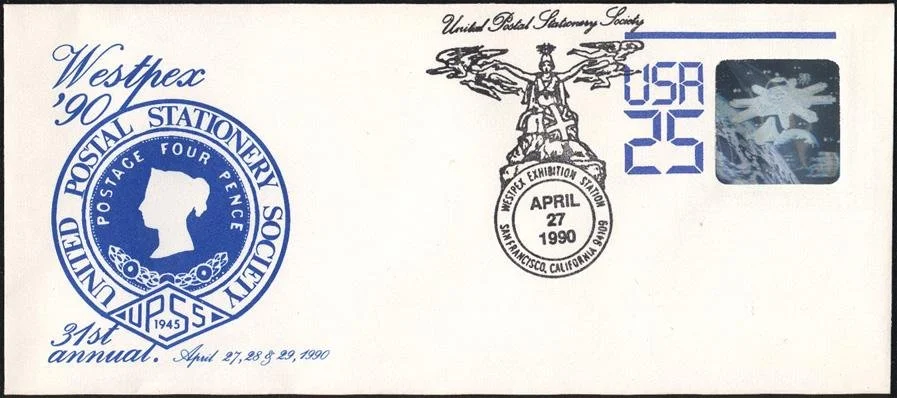
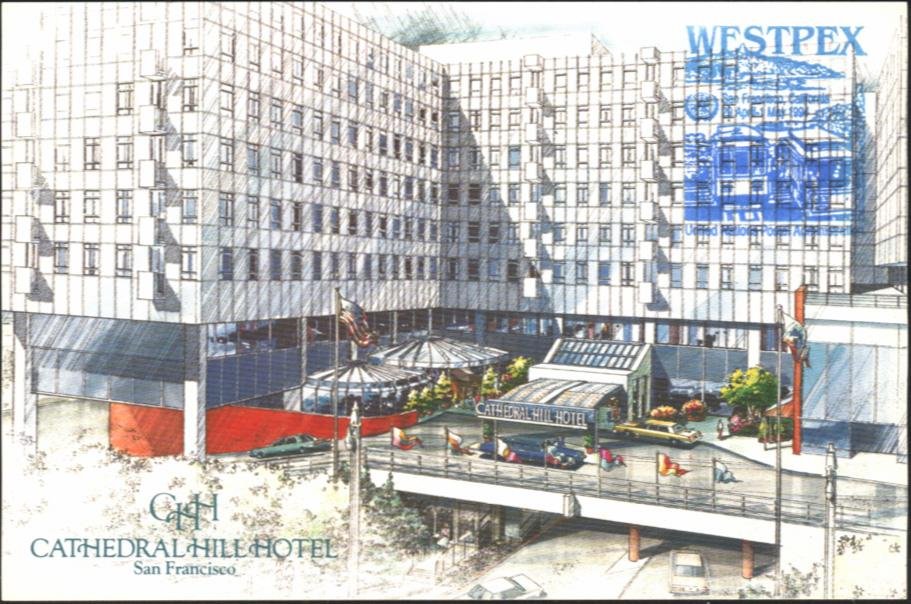
The 31st show in 1990 ran at a Cathedral Hill Hotel celebrating its own 30th anniversary. WESTPEX presented a cake and champagne to the hotel’s sales staff. Stamp World London ’90 was scheduled the week after WESTPEX, and there were fears dealers would skip the West Coast show — but 66 still came. The United Postal Stationery Society returned as guest society, marking the 150th anniversary of the Mulready envelope. UPSS produced two cachets: one on the World Stamp Expo ’89 sheets of America the Beautiful postal cards, and the first U.S. hologram stamped envelope. The legal-size holographic envelopes sold out at the show.
The decade’s first loss came in May 1990. Everett Erle — WESTPEX volunteer for 28 years, corporate secretary for five, and a director until his death — suffered a fatal heart attack on a London street while leaving the APS meeting at Stamp World London ’90, walking with Don Day and other East Bay Collectors Club members. WESTPEX donated $1,000 across three philatelic libraries in his memory.
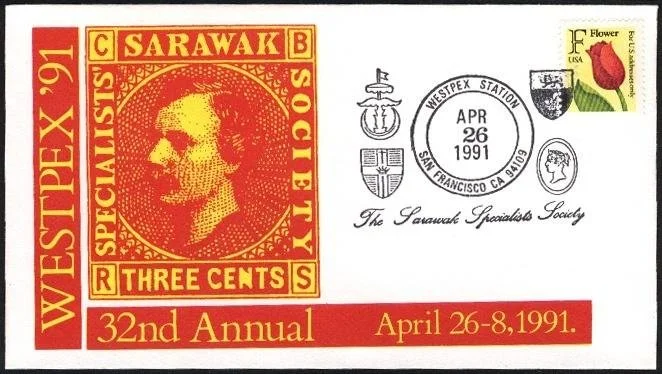
The 1991 show drew unexpected attention from Linn’s — Wayne Youngblood wrote that “even before the show opened at 10 a.m. on Friday, the hall was crowded with collectors waiting to get in,” and noted WESTPEX as “probably one of the most actively involved in the promotion of stamp collecting among youth.” School groups were bused in throughout Friday.
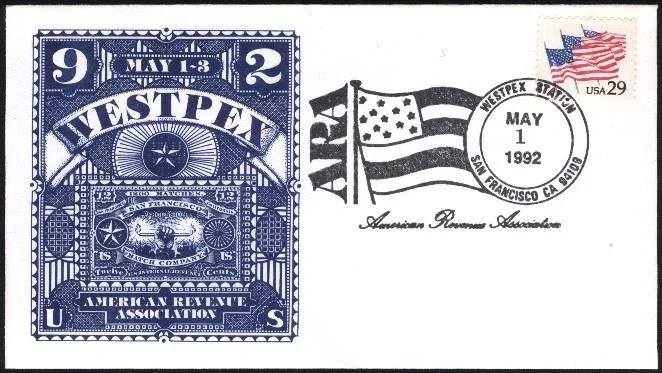
1992 was a different story. National attention was focused on the Los Angeles riots — civil unrest sparked by the acquittal of four LAPD officers in the Rodney King beating. WESTPEX attendance was down 20%; some assumed people stayed home to watch the news. The American Revenue Association was that year’s guest society; vice-president Richard Friedberg suggested a San Francisco Match Company revenue stamp for the cachet, issued in a striking blue. The board also adopted a new policy that year that signaled the era: no smoking in the exhibition and dealer rooms.
Three Chairmen in Three Years, 1993 – 1994
William Oliver retired as WESTPEX chairman in 1993 after ten years — the show had been led by just three men in its first 33 years: Clary for ten, Thompson for thirteen, Oliver for ten. Charles Waller, an eleven-year volunteer and former Council president, took over.
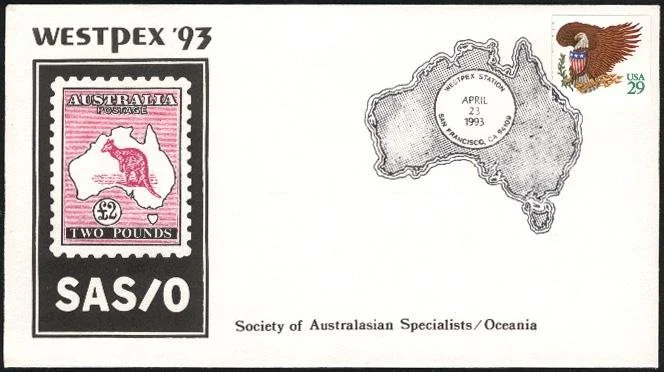
The Cathedral Hill Hotel was sold to a Korean investor and briefly renamed Quality Inn Downtown. Confused customers and weakening hotel services led the new owners to revert to the Cathedral Hill name within the year. The Society of Australasian Specialists/Oceania was the headline guest society, with three more (Nepal & Tibet Study Circle, Tonga & Tin Can Mail Society, U.S. Philatelic Classics Society) also participating. Noel Bond designed three cachets.
Waller served only one year. He resigned at the end of 1993 to care for his wife and to devote more time to his role as chief financial officer of Pacific ’97, the international stamp show coming to San Francisco in three years. George Shalimoff, a three-year volunteer, took over as the fifth WESTPEX chairman for the 35th show. Gayle Hamilton — daughter of long-time WESTPEX secretary Adrienne O’Neill — joined that year as recording secretary; she would serve twelve years and remains an active volunteer and Honorary Director.
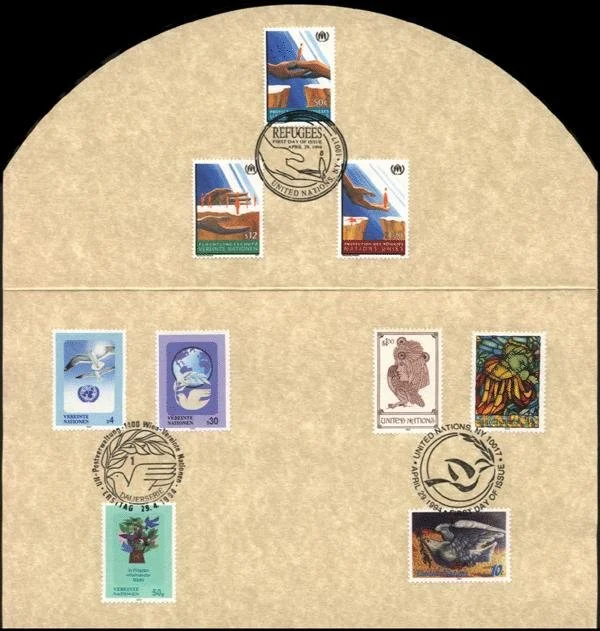
1994 was a landmark year for another reason. The United Nations Postal Administration held a First Day Ceremony at WESTPEX on Friday morning, April 29 — the first day cover designed by UN Philatelists member Herby Lam, hosted by Jill Kearns, Chief of the UNPA. Attendees received a tri-fold folder containing three United Nations Protection for Refugees stamps and six new definitives. An unprecedented UN souvenir cachet was distributed at the Awards Banquet — reportedly the first UN souvenir ever postmarked on a Saturday.
The 35th show ran eleven seminars — a WESTPEX record — open to the public, on subjects from Danish parcel post stamps to detection of damaged or altered stamps to participating in stamp auctions. Six were taught by dealers who took time off from manning their booths. Three guest societies graced the show: the Military Postal History Society (formerly the War Cover Club), the Scandinavian Collectors Club, and the U.S. Philatelic Classics Society.
Building Toward Pacific ’97, 1995 – 1996
1995 was the 50th anniversary of the United Nations Charter, signed in San Francisco in 1945, and the United Nations Philatelists were guest society. The Bureau of Engraving and Printing brought a six-frame exhibit, 100 Years of U.S. Stamp Production, 1894 – 1994, including source art for the 1898 10¢ stamp (long believed lost, found in BEP files in 1991) and signed Roosevelt approvals from World War II.
1996 was bigger and broader. From 959 admission slips, attendees came from 24 states beyond California and seven foreign countries. The Society of Israel Philatelists returned for the fourth time. The American Philatelic Congress gave away 500 hardbound books — a $25 value — to the first three-day-ticket purchasers, partly to publicize the upcoming Pacific ’97. To show the chairman did every job, Shalimoff personally picked up the gold tablecloths from the hotel and used his mother’s sewing machine to mark the 6-foot ones with colored thread (the laundry kept washing out the laundry-marker corners).
And the founder was gone. Joseph M. Clary, “Mr. WESTPEX,” passed away on August 8, 1996. He had chaired every show from 1960 through 1969, served as vice-chairman for the entire next twenty-seven years, and given thirty-six years of service to a show he’d helped invent.
The Year Without WESTPEX, 1997
There was no 38th WESTPEX in 1997. There was something larger.
World Philatelic Exhibitions come to the United States only once a decade. In 1986 — eleven years before the show — the Pacific ’97 organizing committee under Eugene Tinsley (the WESTPEX trademark attorney from 1962, who had served on the WESTPEX jury nine times) explored Los Angeles and San Francisco. WESTPEX donated $250 to support the bid. In 1987, San Francisco was selected. Over the next decade, WESTPEX volunteers worked on Pacific ’97 alongside their own annual show; WESTPEX pledged $25,000 to the show’s Guarantee Fund. With Pacific ’97 scheduled for May 29 – June 8, 1997 at Moscone Center — just five weeks after WESTPEX’s usual late-April dates — the WESTPEX board voted a one-year hiatus to let volunteers focus on the international show.
Pacific ’97 filled 400,000 square feet at Moscone Center: 218 dealers, 133 post offices, and 4,000 frames of exhibits. The opening-day ceremony for the new Benjamin Franklin souvenir sheet drew an estimated crowd of 2,000. Admission was free — the first international stamp show in North America without an entry fee.
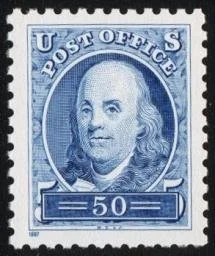
At Pacific ’97, the American Philatelic Society inducted Joseph M. Clary into the Philatelic Hall of Fame, a year after his death — recognition reserved for deceased philatelists who made “outstanding contributions to the advancement of national or international philately.” Mr. WESTPEX took his rightful place there.
The international show was a philatelic success but a financial disappointment, ending deeply in debt. WESTPEX’s pledged seed money was committed; an additional pledge was requested. Steve Schumann and Bill Ninde — board members of both organizations — counseled patience. By January 1998, Pacific ’97 had enough in hand to settle with creditors. WESTPEX was not asked to contribute beyond what had been spent.
WESTPEX bought twenty extra exhibit frames from Pacific ’97 at the close, bringing its 16-page frame inventory above 320. The show that had skipped its own 38th year for the world’s biggest stamp exhibition picked itself up and started planning the 38th show for April 1998.
← The 1980s · ↑ All eras · Continue to The 2000s →
Adapted from WESTPEX – The First 50 Years by Kristin Patterson, © 2010 WESTPEX, Inc. · About this history →